Snooker Cues
Classic cues with a smaller tip diameter, dedicated to snooker.
New listings: Snooker Cues
One email a day, only when something new appears in this category. Unsubscribe with one click.
No spam. Unsubscribe link in every email.
About Snooker Cues
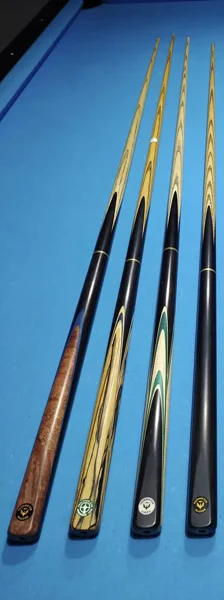
Snooker cues differ from pool cues in almost everything except length, so a proper snooker cue is a separate purchase rather than a substitute for a pool cue. The shaft is thinner: the tip is 9–10.5 mm instead of 12–13 mm, the ferrule is brass, and the wood is almost always ash with visible grain that players set facing up and use as a reference when aiming. This category holds new and used cues from players, clubs and shops: factory Peradon, BCE and Riley, handmade O'Min and Master Cue, and custom cues from Polish makers, all with no selling commission.
Ash or maple. Ash has clear arrow-shaped grain and is slightly more flexible, which gives the characteristic soft feel on screw shots. Maple is smooth and plain, so it suits players who find the grain distracting when aiming. Tournament snooker is dominated by ash, but that is habit rather than a technical advantage.
3/4 or 1/2. A three-quarter joint sits a quarter of the way from the butt, so your bridge hand holds a single piece of wood and the joint stays well behind the grip hand — the tournament standard. A half joint splits the cue in the middle: easier to carry and cheaper, but a joint in the middle changes the feel of the hit. A one-piece cue gives the cleanest feel, but needs a 147 cm case.
Length and weight. The standard is 57 inches (145 cm) and 17–19 oz. A player over 185 cm reaches for 58 inches, over 190 cm for 58–59 inches with an extension. A 9.5–10 mm tip is the sweet spot: below 9.5 mm you gain precision on thin cuts, above 10 mm the cue forgives more stroke errors.
Which snooker cue should a beginner buy?
To start, an ash 3/4 cue with a 10 mm tip and 17–18 oz weight is enough — you will find those in complete snooker cues. The cheapest listing in this category right now is 100 zł. If you already own a butt, add a shaft or an extension separately; butts alone also appear on BidBil. Retipping and ferrule work is in the cue service section, and the tables you play on are in snooker tables. The full comparison — ash or maple, 3/4 or 1/2 and what a good cue costs — is in the guide, and cue care plus the snooker counter are covered separately.